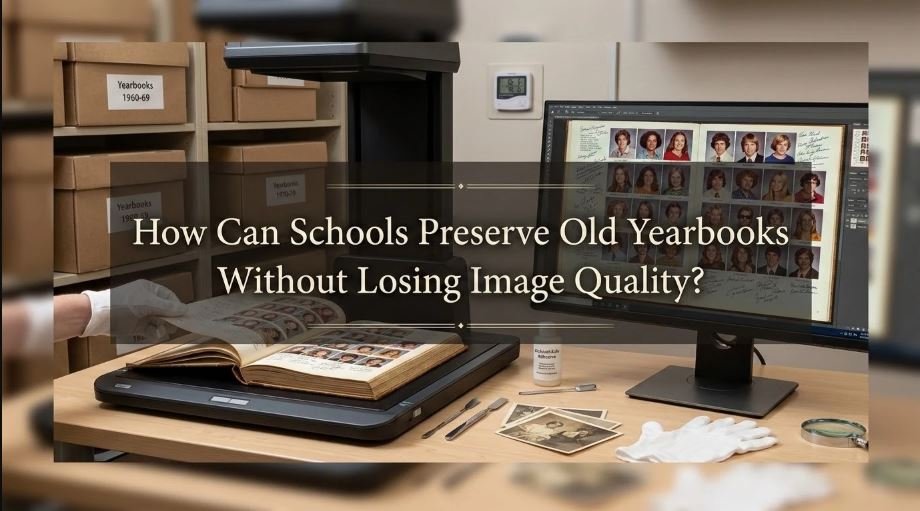
Walk into almost any high school library in America and you will find a back room or a locked cabinet holding decades of old yearbooks. These volumes are vital historical records of the local community. But paper degrades and glue dries out. The ink from a 1978 print run eventually starts fading.
Schools frequently realize they need to secure digital copies before the physical assets fall apart entirely. The problem is that capturing high quality images of thick bound books is incredibly difficult. If you handle the process incorrectly, you destroy the original book and end up with terrible digital files. Preserving these books requires a specific operational approach to keep both the physical object and the image quality intact.
The Trap of Office Scanners
To save money, many schools have staff or students use a regular library copier to scan yearbooks. It sounds highly practical until you review the output files. Bound books simply do not lay flat on glass. Forcing them flat breaks the dried glue and cracks fragile older spines. If you do not force them flat, you get a dark shadow right down the center of the image. The text curves into the binding and becomes completely unreadable.
Standard office scanners also apply automatic compression designed for text documents. A high contrast photo from the 1960s ends up looking like a blurry thumbnail. On top of the poor image quality, there is a massive administrative burden:
- Someone has to manually scan hundreds of pages.
- They must name the files.
- They must collate them into a single document.
It takes hundreds of hours of staff time to produce a subpar result.
Handling Print Patterns and Visual Glitches
Vintage yearbooks were primarily printed using offset lithography. The photographs on those pages are actually made up of thousands of tiny ink dots called halftones. When a standard digital sensor captures those dot patterns at the wrong resolution, it creates an optical illusion known as a moiré pattern. The digital image looks like it has a strange wavy grid layered over the faces of the students.
Getting rid of this interference requires specific optical settings and descreening software. It takes specialized camera equipment to capture the page clearly without triggering that optical grid. This technical hurdle is usually the exact moment schools start looking for the best yearbook digitization service rather than trying to figure out optics and software filters in house. Professionals have the hardware required to capture halftones smoothly.
Planetary Scanners and Non Destructive Capture
Professional digitization operations rely on planetary scanners instead of flatbeds. The book is not placed face down on a glass plate. Instead, the yearbook sits face up on a specialized v-shaped cradle. A high resolution camera mounted on a column directly above the book captures the image.
The cradle automatically adjusts to the thickness of the spine. It holds the pages flat with gentle angled pressure or thin glass plates that do not strain the fragile binding. Glossy pages from the 1990s often reflect light and cause glare on standard scanners. Planetary setups use angled LED lighting arrays to eliminate hot spots entirely. This non destructive method captures crisp edge to edge images without tearing a seventy year old binding apart.
Workflow Options for Bulk Projects
There is another operational route if the school has multiple copies of the exact same volume. Some schools keep three copies of every year in storage but only need one pristine physical copy for the permanent archive. In those situations, the spine of the duplicate copy is sliced off using an industrial paper cutter.
The loose pages are then fed through high speed sheetfed scanners. This destructive method is incredibly fast and produces perfectly flat images with zero gutter distortion. A competent yearbook scanning service will usually offer both workflows. They will ask you to separate your inventory. You tell them:
- Which volumes are rare single copies that require careful cradle handling.
- Which ones are duplicates that can be sacrificed for speed and cost savings.
Managing Color Depth Across Decades
Yearbook printing evolved dramatically over the decades.
- 1950s: Books from 1950 are entirely black and white.
- 1970s: A volume from 1975 might be mostly grayscale with a few full color insert pages for homecoming or prom.
- 1990s: Books from the late 1990s are heavily saturated full color prints.
Scanning a massive project in generic grayscale loses vital historical detail from the newer books. Scanning everything in heavy color wastes an enormous amount of server storage space on pages that only contain black ink. The capturing process needs to be adjusted based on the era of the book. Operators must calibrate the color depth settings batch by batch so the digital files accurately represent the original print run without creating unnecessarily bloated file sizes.
File Formats and Long Term Access
Capturing the images is only the first phase of preservation. You need digital files that actually serve your school community and administration.
Master Archive Formats
Schools should always ask for uncompressed TIFF files as their master archive. These are massive files but they contain all the original optical data. You lock those master files away on a secure school server or cloud backup and never touch them for daily use.
Everyday Access Formats
For everyday access by alumni or the front office, you need multi page PDFs with optical character recognition applied. This processing makes the text on every page fully searchable. A staff member can type in a specific student name or a graduation year and the PDF will immediately jump to the correct page. This turns a dusty artifact sitting in a library closet into a highly functional searchable database for your school..
