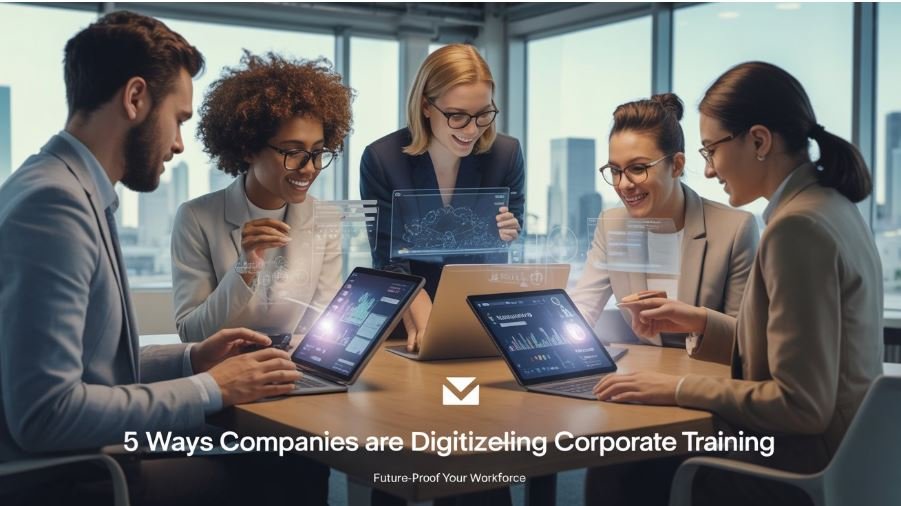
In today’s world, companies’ approaches to staff training are undergoing an enormous digital transformation. Companies are using technology to create more flexible, effective, and engaging training programs.
Digitizing corporate training allows continuous learning, scalability, and accessibility across a global workforce, making it essential for competitive companies. This blog will examine five ways companies are digitizing corporate training and how these innovations are changing employee development.
What Does it Mean to Digitize Business Processes?
The digitalization of business processes is helping technology to streamline or enhance your business operations. The term “digitization” refers to the conversion of physical documents to digital formats. It helps you achieve your digital transformation goals.
Digitization is a dynamic process that appears different in each business. For a small firm, it might be as simple as transferring paper documents to digital formats and informing clients that you are going paperless. For a startup, this could entail developing an app to expedite and automate the consumer experience.
If you work in human resources, your digitization approach may begin with improving employee onboarding or other tools you use daily.
5 Key Ways Companies Are Digitizing Corporate Training
Here are some ways that help companies in their corporate training.
- Virtual Learning Platforms
Many companies use VLPs to administer, deliver, and track online training programs. These platforms enable companies to create customized courses, host webinars, track employee progress, and provide interactive learning experiences.
VLEs and LMSs are accessible, scalable, and flexible. Employees can access training materials on any device at any time. It makes self-paced learning easier. This increases employee engagement and ensures scalable, uniform learning across large teams or global enterprises. Companies may track performance and identify knowledge gaps using real-time VLE tracking and reporting. Here are some platforms that help you to simplify your work.
Moodle is an open-source platform noted for its versatility. On the other hand, Cornerstone is a comprehensive LMS that offers workforce management and learning solutions.
TalentLMS is a cloud-based system that is easy to use and suitable for all kinds of enterprises.
These are prominent examples of Virtual Learning Platforms. These platforms pioneer the digitization of corporate training, encouraging employees to grow.
- E-Learning Modules and Microlearning
Microlearning is a type of e-learning that delivers brief, targeted lessons on specific skills or concepts, designed to enhance learning and retention. Employees can study at their own pace; there is no need to go anywhere. It is cost-effective, and bite-sized content increases engagement.
Companies utilize microlearning to teach critical concepts in short, concentrated modules. Udemy for Business and LinkedIn Learning offer many professional-focused microlearning courses. These solutions enable on-demand, adaptable training that boosts retention while saving time and money.
- Gamification of Training
Gamification in corporate training incorporates elements such as points, badges, leaderboards, and challenges to make learning more engaging and participatory. This technique has gained popularity as companies seek ways to boost employee engagement, motivation, and knowledge retention. Gamification improves learning retention by making it fun and rewarding for employees to engage.
Gamification increases engagement, rewards, and motivation to complete training programs. The fun quiz-based platform Kahoot, Quizlet, which lets users create flashcards and study games, and custom gamified Learning Management Systems (LMS) that provide tailored, interactive learning experiences are popular gamified learning solutions. These tools help firms make training more engaging.
- Virtual Reality (VR) and Augmented Reality (AR) in Training
VR and AR offer immersive, hands-on experiences that closely mirror real-world settings, transforming corporate training. VR delivers a totally immersive environment where employees can practice activities in a simulated setting, while AR allows them to interact with virtual items in their real world.
VR/AR training benefits the healthcare, industry, and retail sectors. VR enables surgeons to practice surgery safely, while AR assists manufacturers in training equipment maintenance workers. AR helps retailers simulate product demos and customer service.
These tools help employees practice complex tasks, eliminate errors, and build confidence before applying their skills in real-life situations. Interactive, realistic, and successful learning with VR & AR.
- AI and Chatbots for Personalized Learning
Personalizing employee learning with AI is changing business training. AI-powered systems may analyze learner data and customize content to employee roles, talents, and learning preferences. This strategy boosts productivity by providing customized and engaging content.
Personalize learning with AI-driven content recommendations and chatbots. Chatbots facilitate staff training, answer questions, and provide feedback. AI-driven module recommendations let learners explore content by progress and style.
AI learning aids, such as Mya and Watson, provide personalized and interactive learning. AI-powered image-to-text solutions let staff translate schematics and notes into text, making educational materials clearer. Business training becomes dynamic, entertaining, and adaptive using AI.
Key Advantages of Digitalizing Business Processes
Digitizing corporate operations can be time-consuming, especially when using paper documents, physical file systems, or legacy software. However, digitizing corporate operations can help you become more structured and stay competitive in the digital age. Here are four advantages of beginning your digital transformation immediately.
Streamline Workflows
First, digitizing business processes enables you to streamline operations by identifying inefficiencies and eliminating unnecessary steps. Many manual processes, such as form filling and data entry, can be eliminated through digitalization, while other steps can be streamlined or reordered using workflow charts to maximize efficiency.
Improve the User Experience
Digital workflows can improve the user experience for both customers and staff. Customers are accustomed to self-service portals, where they can log in and resolve their own issues, and many staff members appreciate the flexibility of remote work. Digitizing business procedures enables you to meet evolving user expectations.
Reallocate Resources
Digitization offers the opportunity to save time and money by eliminating unnecessary work and expenses. From saving physical storage space to reducing the risk of human errors, digitalization enables you to manage resources more efficiently and devote more time and attention to the aspects that provide the most value to your business.
Promote Innovation
Ultimately, automating your company’s processes enables you to innovate and stay ahead of the competition. Creating a low- or no-code software, a customer service chatbot, or improving workflows can give you a competitive edge.
Conclusion
Businesses need to digitize their corporate training to stay competitive in the modern workforce. These digital technologies, ranging from Virtual Learning Platforms to AI-driven personalization, enhance employee engagement, training outcomes, and flexibility and accessibility.
Digital training enables businesses to deliver ongoing, scalable, and cost-effective learning opportunities for their teams, fostering growth and development. Corporate training will become more engaging, efficient, and effective as organisations adopt gamification, VR/AR, and AI. Organisations must prioritise and invest in digital training solutions to stay competitive in today’s rapidly changing market.
